The argan oil market has grown considerably over the past decade. Consequently, so has the number of products that use the name while delivering something far removed from the real thing. Diluted formulas, roasted variants, synthetic additives; all of them sold under the same label, at wildly different price points, with the same promises on the packaging.
Choosing a pure cosmetic argan oil is not complicated. However, it does require knowing what to look for; and what to walk away from.
Start With the Ingredient List
The most reliable indicator of purity is also the simplest: the ingredient list. A genuine, pure cosmetic argan oil contains exactly one ingredient; Argania Spinosa Kernel Oil. Nothing else.
If the ingredient list includes silicones (dimethicone, cyclopentasiloxane), mineral oils (paraffinum liquidum), fragrance (parfum), or preservatives, the product is not pure argan oil. It is a blend, formulated to reduce cost or extend shelf life — and the concentration of actual argan oil may be as low as 2 to 5%.
In addition, watch for products listing argan oil low on the ingredient list. By law, cosmetic ingredients are listed in descending order of concentration. If Argania Spinosa Kernel Oil appears after five or six other ingredients, it is present in trace amounts only.
Look for Cold-Pressed Extraction
The extraction method directly determines the quality of the oil. Cold pressing ; extracting oil from the kernel at controlled low temperatures ; preserves the full nutritional profile: vitamin E tocotrienols, oleic and linoleic fatty acids, squalene, and polyphenols. These are the compounds responsible for argan oil’s effectiveness on skin and hair.
Heat-based extraction, by contrast, is faster and cheaper. However, it degrades a significant portion of these bioactive compounds in the process. The resulting oil is cheaper to produce but notably less effective.
Always look for “cold-pressed” stated explicitly on the label or in the product description. If the extraction method is not mentioned at all, that absence is itself informative.
Check for Organic Certification
Organic certification is not merely a marketing badge. For cosmetic argan oil specifically, it verifies three things: that the argan kernels were harvested without the use of synthetic pesticides or chemicals, that the extraction process meets defined purity standards, and that the supply chain has been independently audited.
The most recognised certifications for cosmetic argan oil are:
- ECOCERT : the leading European organic certifier for cosmetics
- USDA NOP : the United States Department of Agriculture organic standard
- EU Organic : the European Union’s official organic certification
A product carrying any of these certifications has been independently verified, not simply self-declared. Moreover, these certifications also tend to correlate with ethical sourcing ; fair compensation for the women’s cooperatives who hand-crack the argan nuts, a process that cannot be mechanised and remains entirely dependent on skilled human labour.
Read the Colour and Scent
Pure cold-pressed cosmetic argan oil has a distinctive appearance and scent that makes it easy to identify once you know what to look for.
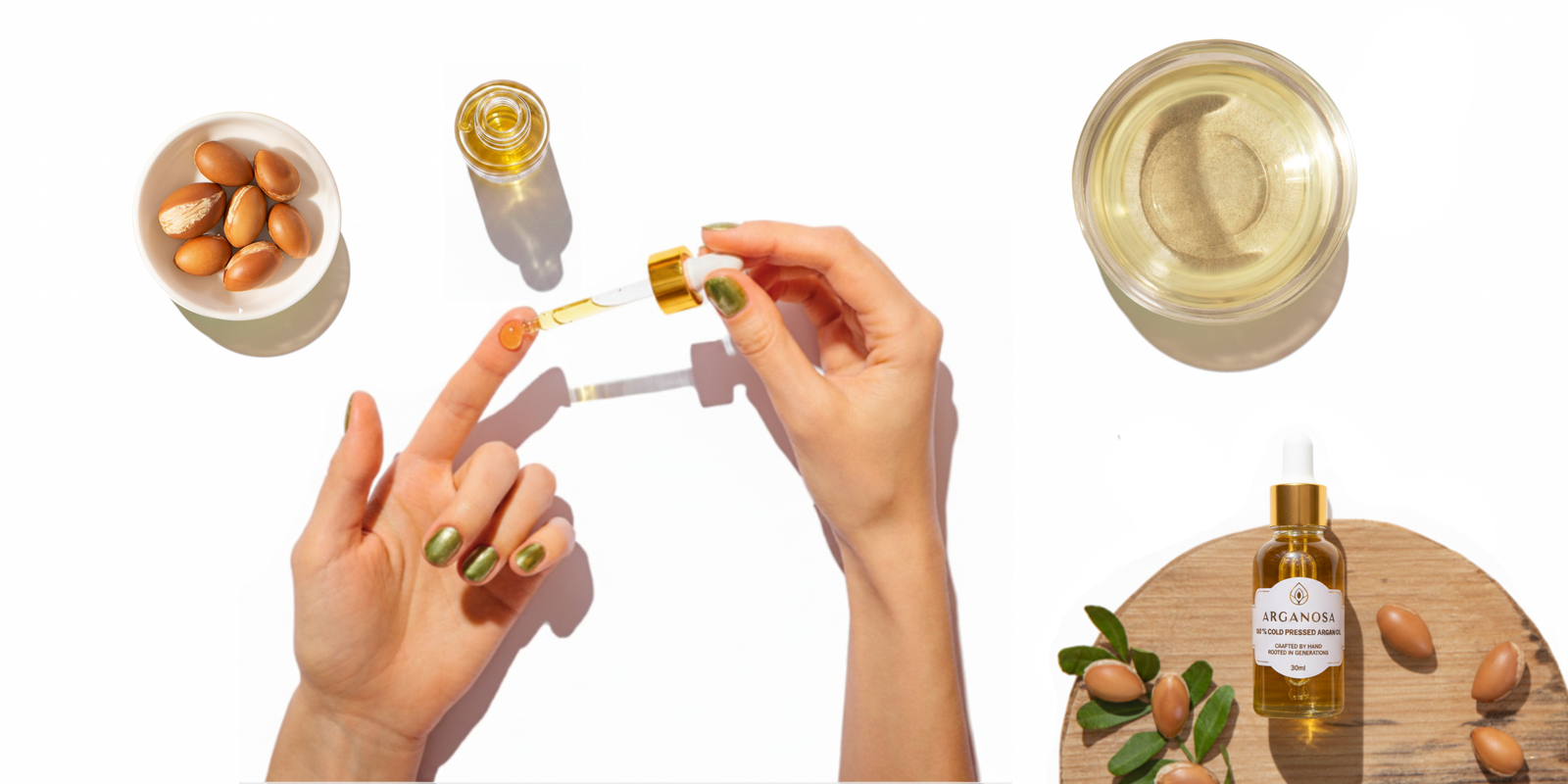
Colour: pale to medium gold ; clear and luminous, never dark or opaque. A deep amber colour indicates the kernels were roasted before pressing, which is the production method for culinary argan oil and renders it unsuitable for cosmetic use.
Scent: neutral to very faint, fading within minutes of application. A strong nutty aroma, again, points to roasted kernels. A chemical or synthetic fragrance indicates additives.
Texture: completely dry and fast-absorbing. Pure cosmetic argan oil leaves no greasy residue. If the oil sits heavily on skin or hair without absorbing, it has likely been blended with heavier carrier oils.