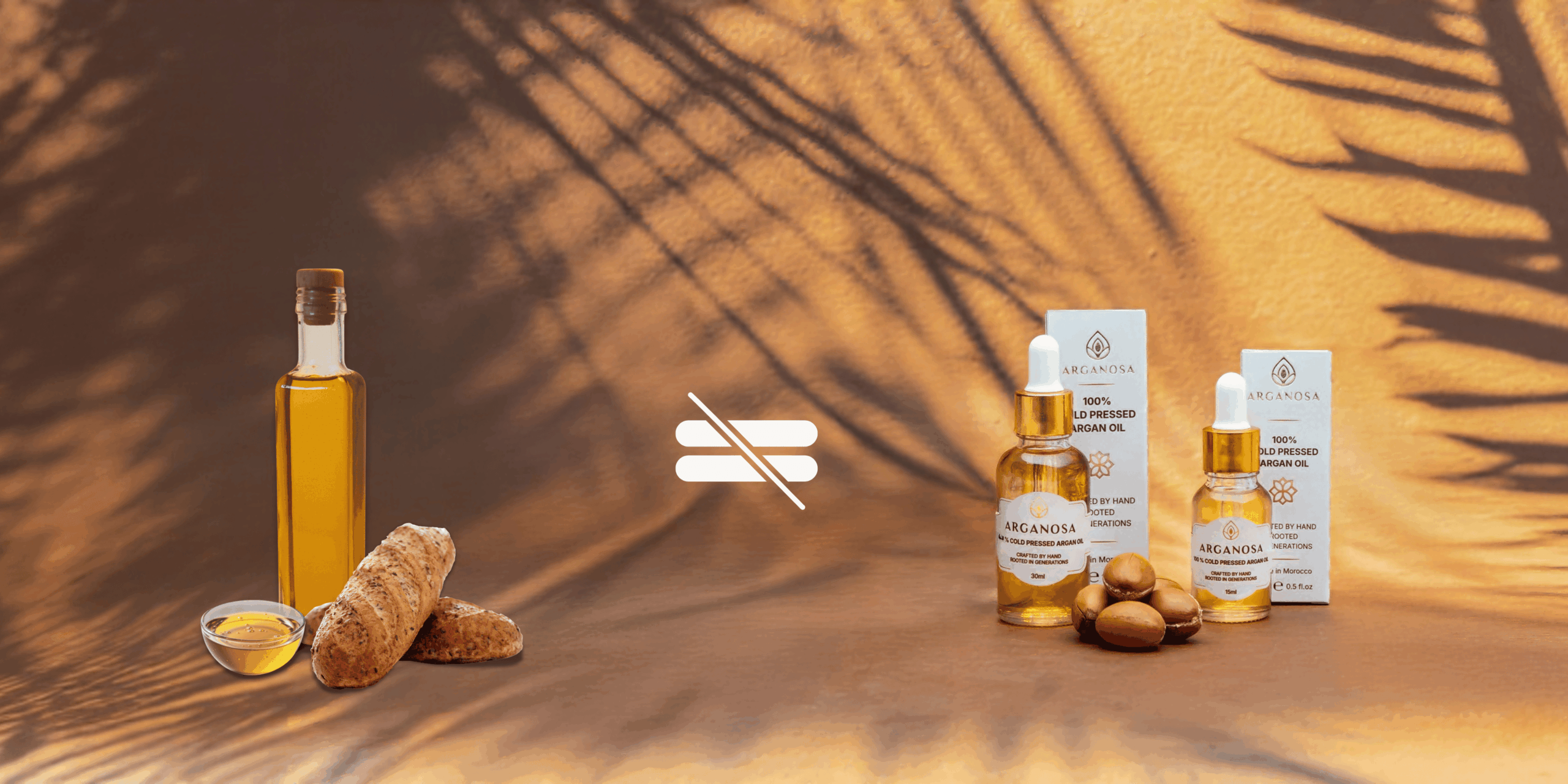
Same tree. Same kernels. Completely different oils.
If you have ever wondered whether the argan oil in your kitchen cabinet could double as a hair treatment, or whether the bottle on your vanity is the same as what Moroccan families drizzle over their couscous, the answer is no. And the reason why tells you everything about what makes a truly exceptional cosmetic argan oil.
They Begin the Same Way
Both culinary and cosmetic argan oil are cold-pressed from the kernels of the Argania Spinosa tree, native to the Souss-Massa region of southwestern Morocco. The tree itself is the same. The harvest is the same. The women who crack open the hard argan nuts by hand are often the same cooperative workers.
The difference begins at the roasting stage, and from that point forward, the two oils diverge completely.
Culinary Argan Oil: Roasted for Flavour
To produce culinary argan oil, the cooperative lightly roasts the kernels before pressing. This roasting process develops the oil’s distinctive flavor – rich, nutty, warm – which is why Moroccan cuisine prizes it as a finishing oil, drizzled over AMLOU (a traditional almond and honey paste), salads, and grilled dishes.
The roasting also darkens the oil, giving it a deep amber colour and a pronounced aroma. These are desirable qualities at the dining table. On your skin or hair, however, they are not.
The heat from roasting alters the oil’s molecular structure. The heat degrades a portion of its vitamin E content, polyphenols, and essential fatty acids, and it’s the very compounds responsible for its cosmetic effectiveness. What remains is flavorful, nutritious to eat, and completely unsuitable for topical use.
Cosmetic Argan Oil: Raw, Cold-Pressed, and Unaltered
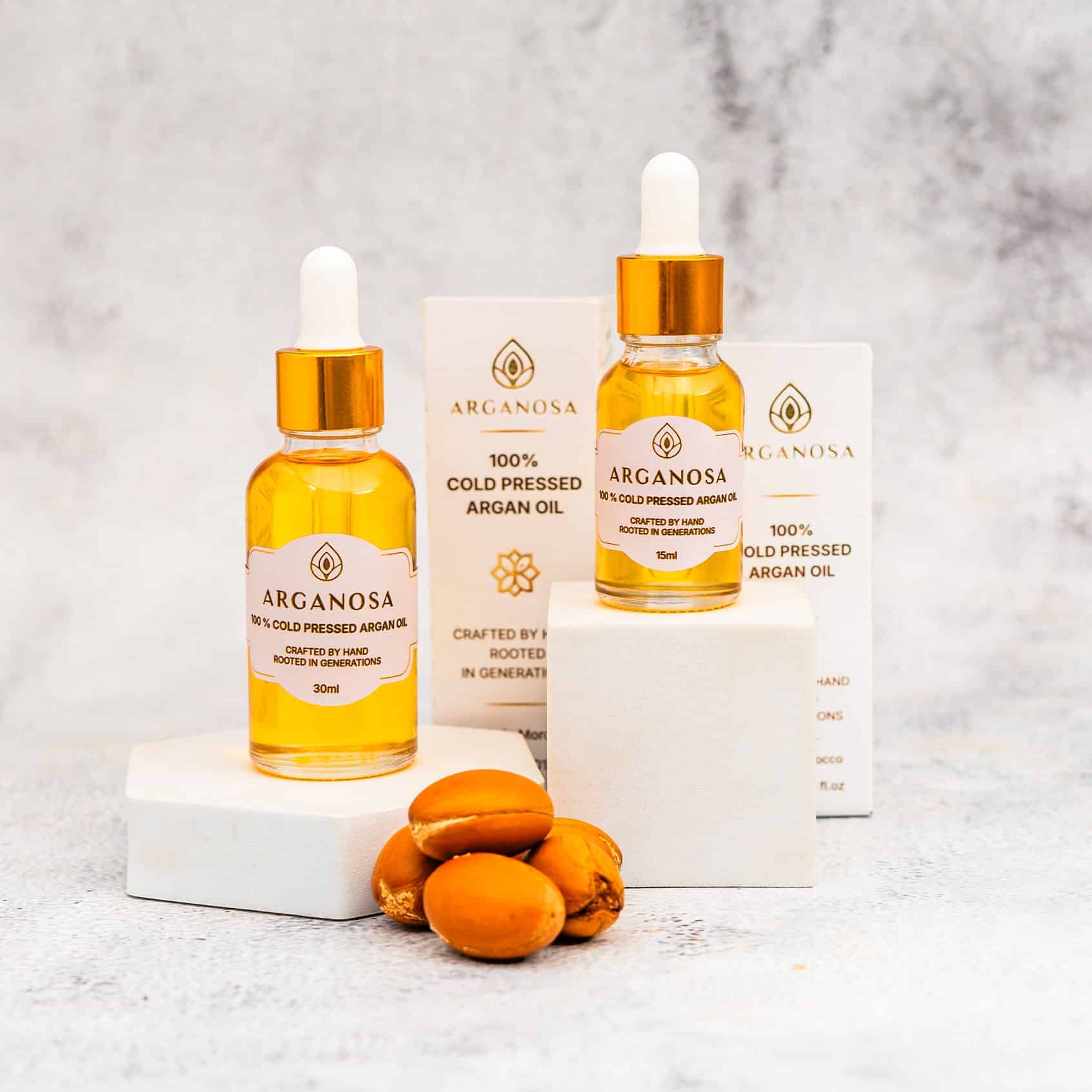
Cosmetic argan oil skips the roasting entirely. artisans press the kernels raw, at controlled low temperatures, to preserve the full integrity of the oil’s bioactive compounds.
As a result, the oil looks visually distinct: a lighter, golden color, and a neutral scent that fades within minutes of application. More importantly, the oil retains its complete nutritional profile, high concentrations of vitamin E tocotrienols, oleic and linoleic fatty acids, squalene, and natural polyphenols. Together, these are the compounds that make argan oil effective for skin hydration, hair repair, and nail care.
This is why cosmetic argan oil absorbs so cleanly and completely. In short, there is nothing altered, nothing degraded, only the pure extract of the kernel, exactly as nature produced it.
How to Tell the Difference
When shopping for cosmetic argan oil, these are the markers that matter:
Colour: pale to medium gold. Dark amber signals roasting.
Scent: neutral to very faint. A strong nutty aroma means the kernels were roasted, and the oil is culinary grade.
Texture: completely dry and fast-absorbing. Any heaviness or greasiness suggests either low-quality pressing or the addition of other oils.
Certification: look for ECOCERT organic certification, which verifies both the quality of the oil and the ethics of its production. USDA NOP and EU Organic certifications are equally reliable indicators.
Ingredient list: it should read Argania Spinosa Kernel Oil and nothing else. Any additional ingredients, fragrances, or preservatives dilute the product and reduce its efficacy.